
Parse.ly review (2026): is it worth it?
Content analytics for publishers and editorial teams
Black Friday: is there a Parse.ly sale?
Parse.ly report card
Weak · out of 4.0 · graded Nov 12, 2026
Best for analytics for publishers
Parse.ly tracks how articles perform and connects readers to conversions, with an API and data pipeline. It's built for publishing, not apps, shows no prices, and each tier caps you at 1, 2 or 3 sites.
Who Parse.ly is for
- Fits if you run a news or content site and care which articles earn attention
- Works for a publisher on WordPress that wants article-level numbers
Who Parse.ly is not for
- Skip it if you want a price on the page, as there isn't one
- Not for you if you need a free plan or trial, as none is listed
- Skip it if you want app or product analytics, since it's built for content publishing
- Watch out: the three tiers cap you at 1, 2 or 3 sites tracked
Why Parse.ly gets a 1.6
Five grades, each with its reason. The GPA is their average: an A is 4 points, an F is none.
- CValue for moneyThree tiers are named but no price is shown, so what it costs isn't public.
- FFree plan and trialNo free plan or free trial is listed on the pricing page.
- CFeaturesContent dashboard, conversion and attribution reports, a content API, a data pipeline and AI insights. It does the publishing job fully but isn't a general product-analytics tool.
- CEase of useNo store rating on record. It's a dashboard and API to learn, not something you start with in five minutes.
- CPlatforms and integrationsWeb only, with a WordPress connection listed and an API.
What these grades rest on. Graded from this listing, whose facts were read from WPVIP Inc.'s own pages on 12 November 2026. Not based on using the product, and shorter than our full reviews. How we review and grade.
Make Parse.ly? Put this grade on your site

Paste this where you want the badge. It links here and follows the grade if it changes. About badges
<a href="https://toolgpa.com/tools/parsely#review"><img src="https://toolgpa.com/badge/parsely.svg" alt="Parse.ly: 1.6 GPA on ToolGPA" width="196" height="56"></a>Where Parse.ly stands among website and product analytics tools
Parse.ly's GPA of 1.6 is higher than 0 of the 58 other website and product analytics tools we grade, and level with 6.
It stands best on value for money (C, above 5 of 58) and worst on free plan and trial (F, above 0).
Each grade against the category
Every bar is all 59 website and product analytics tools we grade, cut by the letter each got. Parse.ly’s own letter is outlined.
- CValue for moneyAbove 5 of 58, level with 36
- FFree plan and trialAbove 0 of 58, level with 11
- CFeaturesAbove 1 of 58, level with 31
- CEase of useAbove 3 of 58, level with 49
- CPlatforms and integrationsAbove 0 of 58, level with 19
Keep Parse.ly, or make your own?
Keep it
The plain part of Parse.ly you could make: reports. What surrounds it you could not. The 5 things listed below take a company, not a weekend.
That makes this kind of software worth paying for, not this one in particular: 52 of the 58 other website and product analytics tools grade higher.
What you could make
- Reports: an app builder makes this well.
What you could not
- A tracking script and a database that counts every visit.
- Connections that pull numbers from dozens of other services.
- It plugs into other products, WordPress among them, and has an API.
- AI features, unless you pay a model provider for each request yourself.
- What a company asks for before it lets staff use something: single sign-on.
What this rests on. Parse.ly’s listing: what it does, where it runs, what it plugs into and what it costs. It is a judgement about the kind of software this is. We have not built a replacement for it, and making your own means looking after it too. How we decide, and every tool’s verdict.
What is Parse.ly?
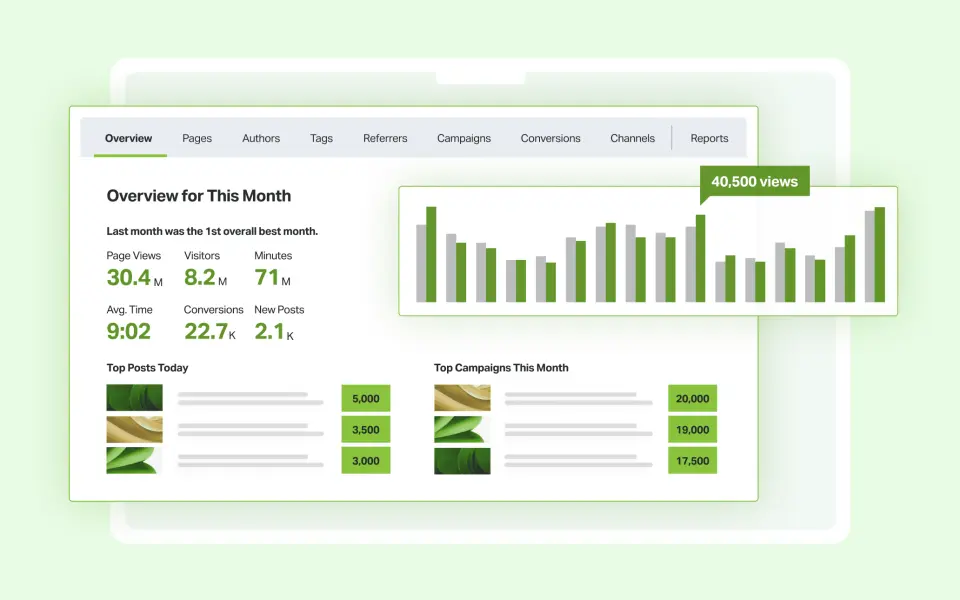
Parse.ly is a content analytics service for publishers and content marketers. It reports on how articles perform with real-time data and engaged-time metrics, and it also offers a content recommendation API, a raw-data pipeline to a warehouse, and AI-assisted insights.
Worth knowing
- The pricing page names three tiers (Content Performance, Content Value, Content Advocacy) but shows no prices, so costs are not public.
- The tiers are limited by sites tracked: 1, 2 and 3 sites respectively.
- Aimed at content publishing; it is not a general product-analytics tool for apps.
Key features
- Content analytics dashboard
- Real-time and historical reports on article performance, with more than 30 audience-centric metrics and 13 months of history on the entry tier.
- Conversion and attribution reporting
- Connects what people read to conversions. Conversions reporting, attribution analytics and audience segmentation start on the second tier.
- Content API
- An API for serving recommended content on your own sites, with customizable models and a WordPress block for placing it.
- Data pipeline
- Streams raw, event-level data from websites and apps into a data warehouse for analysts.
- AI insights
- Answers questions in plain English, tests headlines while content is live, and can be reached from AI assistants through a Parse.ly MCP connection.
- Video and geographic segmentation
- Video tracking and reports by region are listed on the third tier, alongside single sign-on.
Parse.ly pricing
We could not confirm Parse.ly’s current pricing from its own site, so we are not listing plans here. See parse.ly for current prices.
Works with
Parse.ly alternatives
- Parse.ly vs Google Analytics
Free plan
- Parse.ly vs Matomo
Free plan · from $26/mo
- Parse.ly vs Piwik PRO
Free trial · from €36/mo
- Parse.ly vs Plausible
Free plan · from $7.50/mo





Common questions
Does Parse.ly have an Android app?
No Android app was listed when its pages were read on Nov 12, 2026. Parse.ly is listed for Web.
Does Parse.ly have an iPhone app?
No iPhone app was listed when its pages were read on Nov 12, 2026. Parse.ly is listed for Web.
Is Parse.ly open source?
Parse.ly is not described as open source on its own site, as read on Nov 12, 2026.
Does Parse.ly have an API?
Yes. Parse.ly offers a public API, according to its own site.
Sources for this page
The prices, plans, platforms and features above were read from these pages on Nov 12, 2026.