
Passwordstate review (2026): is it worth $368?
Self-hosted enterprise password manager for Windows servers
Black Friday: is there a Passwordstate sale?
Passwordstate report card
Fair · out of 4.0 · graded Nov 12, 2026
Best for a self-hosted password vault for IT teams
Passwordstate is a self-hosted vault for teams, at $368 once for 5 named users plus $73.60 a year for support. The server needs Windows Server, IIS and SQL Server, and several add-on modules cost extra.
Who Passwordstate is for
- Fits if you run Windows servers and want the vault on your own network
- Works for IT teams that need role-based access and audit reports
Who Passwordstate is not for
- Not for you if you do not run Windows Server, IIS and SQL Server
- Pricey if you add support, which renews at 20% of the licence value
- Watch out: the Password Reset Portal, High Availability and Remote Site Locations modules are priced separately
- Watch out: the 30% charity and education discount does not apply to reseller orders
Why Passwordstate gets a 2.2
Five grades, each with its reason. The GPA is their average: an A is 4 points, an F is none.
- CValue for money$368 once for 5 users is about two years of the category's middle subscription for five seats, and support is $73.60 a year on top.
- CFree plan and trialA 30-day trial of the downloadable software; the page does not mention a card. There is no free plan.
- BFeaturesSelf-hosted vault, browser extensions, mobile apps, role-based access, reporting, an API and webhooks, with high availability as an add-on.
- DEase of useNo store rating on record. It needs Windows Server 2022, IIS, .NET Framework 4.8.1 and SQL Server.
- BPlatforms and integrationsWeb, iOS, Android and browser extensions, with Active Directory, Entra ID and PowerShell. No desktop app.
What these grades rest on. Graded from this listing, whose facts were read from Passwordstate's own pages on 12 November 2026. Not based on using the product, and shorter than our full reviews. How we review and grade.
Make Passwordstate? Put this grade on your site

Paste this where you want the badge. It links here and follows the grade if it changes. About badges
<a href="https://toolgpa.com/tools/passwordstate#review"><img src="https://toolgpa.com/badge/passwordstate.svg" alt="Passwordstate: 2.2 GPA on ToolGPA" width="196" height="56"></a>Where Passwordstate stands among password managers
Passwordstate's GPA of 2.2 is higher than 0 of the 27 other password managers we grade, and level with 3.
It stands best on features (B, above 10 of 27) and worst on ease of use (D, above 0).
Each grade against the category
Every bar is all 28 password managers we grade, cut by the letter each got. Passwordstate’s own letter is outlined.
- CValue for moneyAbove 1 of 27, level with 11
- CFree plan and trialAbove 2 of 27, level with 10
- BFeaturesAbove 10 of 27, level with 14
- DEase of useAbove 0 of 27, level with 2
- BPlatforms and integrationsAbove 6 of 27, level with 13
Keep Passwordstate, or make your own?
Keep it
To replace Passwordstate you would be making a password vault, the last thing anyone should make for themselves. That is not a weekend's work, with an AI app builder or without one.
That makes this kind of software worth paying for, not this one in particular: 24 of the 27 other password managers grade higher. It costs $368, paid once.
What you could make
- Reports: an app builder makes this well.
What you could not
- A password vault, the last thing anyone should make for themselves.
- Passkeys, which rest on security you cannot improvise.
- A real app for iOS and Android. Something home-made would be a web page.
- It plugs into other products, Microsoft Entra ID, Active Directory and PowerShell among them, and has an API.
- What a company asks for before it lets staff use something: roles and permissions.
- The depth: we grade its features B, which means it covers the whole job.
What this rests on. Passwordstate’s listing: what it does, where it runs, what it plugs into and what it costs. It is a judgement about the kind of software this is. We have not built a replacement for it, and making your own means looking after it too. How we decide, and every tool’s verdict.
What is Passwordstate?
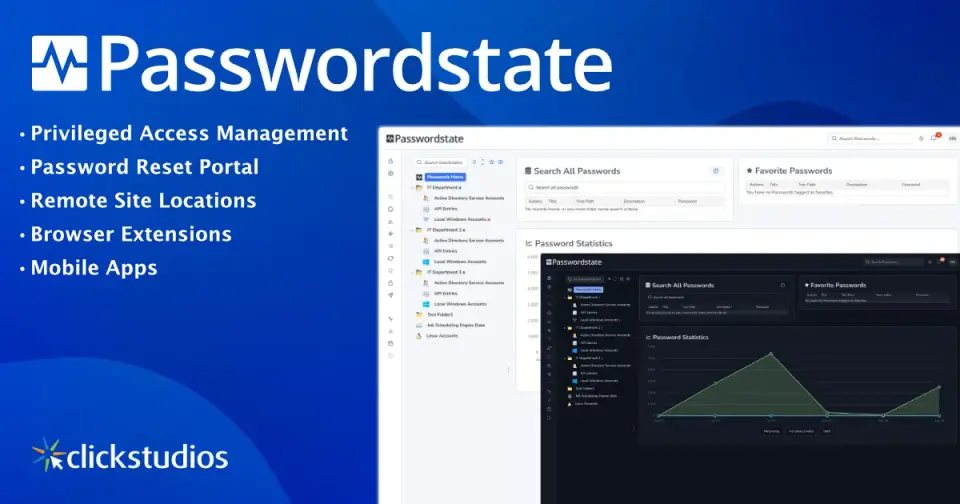
Passwordstate is a password and privileged-access manager that an organization installs on its own Windows server. It is licensed by named users or with an unlimited-user license, and it adds browser extensions, mobile apps, an API and policy controls on top of the shared vault. Click Studios, an Australian company, makes it.
Worth knowing
- The server needs Microsoft Windows Server 2022 or later, IIS, .NET Framework 4.8.1 and SQL Server.
- Support and upgrades are a separate yearly cost, renewing at 20% of the license value.
- A 30% discount is listed for registered charities and accredited education providers, but not for orders through resellers.
- The Password Reset Portal, High Availability and Remote Site Locations modules are priced separately.
Key features
- Self-hosted vault
- Runs on your own Windows server with IIS, .NET Framework and SQL Server, so the password data stays on infrastructure you control.
- Browser extensions
- Extensions for Chrome, Firefox, Edge, Brave and other Chromium browsers save and fill logins and work with passkeys on supported sites.
- Mobile apps
- iOS and Android apps give offline access to cached credentials, biometric unlock and autofill, connected to your own server.
- Role-based access and reporting
- Permissions are set per password list, with compliance reports and audit trails for administrators.
- API and webhooks
- An HTTP API lets scripts and applications retrieve and manage passwords, using PowerShell, Curl and other tools.
- High availability and add-on modules
- Optional modules add a disaster-recovery replica, a self-service Active Directory password reset portal and remote-site agents.
Passwordstate pricing
As of Nov 12, 2026, Passwordstate is a paid product with a free trial, starting at $368 once-off for 5 named users, plus $73.60 a year for support.
- Starts at
- $368 once-off for 5 named users, plus $73.60 a year for support
- Free plan
- None
- Free trial
- 30-day free trial of the downloadable software
| Plan | Price | What you get |
|---|---|---|
| Named Users | $368once-off for 5 users, plus $73.60 per year for support | One production install and a set number of named users (the calculator starts at 5); the cost rises with the user count. |
| Enterprise License | Custom | One production installation with an unlimited number of users; priced in the licence calculator. |
| Global License | Custom | An unlimited number of production installations and users, within one company structure; priced in the licence calculator. |
Read from clickstudios.com.au on Nov 12, 2026. Prices change, so confirm with Passwordstate before you buy.
Ways to pay less
- Nonprofit30% off for charities and education
Registered charities and accredited educational institutions get 30% off Passwordstate and High Availability licenses, with proof of eligibility.
Stated on clickstudios.com.au
Works with
- Microsoft Entra ID
- Active Directory
- PowerShell
- Chrome
- Firefox
- Edge
Passwordstate alternatives
- Passwordstate vs Keeper
Free plan · from $3.58/mo
- Passwordstate vs Passbolt
Free plan · from $4.90/mo
- Passwordstate vs Zoho Vault
Free plan · from $0.90/mo
- Passwordstate vs Bitwarden
Free plan · from $1.65/mo
- Passwordstate vs 1Password
Free trial · from $3.99/mo





Common questions
Does Passwordstate have a Windows app?
No Windows app was listed when its pages were read on Nov 12, 2026. Passwordstate is listed for Web, iOS and Android.
Does Passwordstate have a macOS app?
No macOS app was listed when its pages were read on Nov 12, 2026. Passwordstate is listed for Web, iOS and Android.
Is Passwordstate open source?
Passwordstate is not described as open source on its own site, as read on Nov 12, 2026.
Can Passwordstate be self-hosted?
Yes. Passwordstate's own site says it can be run on a server of your own.
Does Passwordstate have an API?
Yes. Passwordstate offers a public API, according to its own site.
Sources for this page
The prices, plans, platforms and features above were read from these pages on Nov 12, 2026.