
useSend review (2026): is the free plan enough?
Open-source email sender built on Amazon SES
Black Friday: is there a useSend sale?
useSend report card
Fair · out of 4.0 · graded Nov 12, 2026
Best for open-source sending on top of Amazon SES
useSend is an open-source email sender built on Amazon SES, free to self-host and $10 a month on its cloud, which includes 25,000 transactional emails. It depends on SES, so SES account setup and limits apply even to a self-hosted copy, and the free route needs your own server.
Who useSend is for
- Fits if you want open-source software you can host on your own AWS account
- Works for developers who already use Amazon SES
Who useSend is not for
- Skip it if you don't want to set up Amazon SES, as sending runs on it
- Tight if you send marketing mail on the cloud plan, since the $10 covers 25,000 transactional or 10,000 marketing emails, not both
- Watch out: self-hosting means you run the server and pay AWS directly
- Watch out: past the allowance the cloud charges $0.40 per 1,000 transactional and $1 per 1,000 marketing emails
- Watch out: prices are on the home page, as the site has no separate pricing page
Why useSend gets a 2.2
Five grades, each with its reason. The GPA is their average: an A is 4 points, an F is none.
- BValue for moneyThe cloud plan is $10 a month with 25,000 transactional emails, at the cheaper end of the category. Self-hosting costs nothing for the software but needs a server and about $0.10 per 1,000 emails paid to AWS, so it is not counted as free here.
- CFree plan and trialFree to self-host, but you run the server and pay AWS yourself; the cloud edition has no free tier.
- CFeaturesAn API and SDKs, SMTP relay, analytics, a marketing editor and a suppression list, with Amazon SES account setup and limits underneath.
- DEase of useNo store rating on record. The free edition is self-hosted with Docker or Railway, and Amazon SES setup applies to both editions.
- BPlatforms and integrationsA web dashboard and an API; the listing names Amazon SES, Supabase, Railway and Docker.
What these grades rest on. Graded from this listing, whose facts were read from useSend's own pages on 12 November 2026. Not based on using the product, and shorter than our full reviews. How we review and grade.
Make useSend? Put this grade on your site

Paste this where you want the badge. It links here and follows the grade if it changes. About badges
<a href="https://toolgpa.com/tools/usesend#review"><img src="https://toolgpa.com/badge/usesend.svg" alt="useSend: 2.2 GPA on ToolGPA" width="196" height="56"></a>Where useSend stands among email sending services
useSend's GPA of 2.2 is higher than 4 of the 26 other email sending services we grade, and level with 5.
It stands best on value for money (B, above 11 of 26) and worst on ease of use (D, above 0).
Its paid plans start at $10 a month, against a middle price of $13.73 for the category: 6 of the 25 others that charge start lower.
On features, ease of use and platforms it scores 2.0 out of 4. 5 tools score higher and cost less.
Each grade against the category
Every bar is all 27 email sending services we grade, cut by the letter each got. useSend’s own letter is outlined.
- BValue for moneyAbove 11 of 26, level with 12
- CFree plan and trialAbove 4 of 26, level with 17
- CFeaturesAbove 0 of 26, level with 9
- DEase of useAbove 0 of 26
- BPlatforms and integrationsAbove 6 of 26, level with 19
Price against what you get
Each dot is one of 26 email sending services. Further left costs less, and higher up scores better on features, ease of use and platforms. Point at a dot to see which tool it is.
Features, ease of use and platforms, averaged
What paid plans start at, a month (each step along is roughly double) →
- The best score at each price
- Has a free plan
- No free plan
Keep useSend, or make your own?
Keep it
To replace useSend you would be making mail servers with a good name among inbox providers. That is not a weekend's work, with an AI app builder or without one.
That makes this kind of software worth paying for, not this one in particular: 17 of the 26 other email sending services grade higher. It costs $120 a year. useSend is open source, so there is a third way: take its code and run it yourself.
What you could not
- Mail servers with a good name among inbox providers.
- Newsletters sent to thousands of people that still reach the inbox.
- It plugs into other products, Amazon SES, Supabase and Railway among them, and has an API.
What this rests on. useSend’s listing: what it does, where it runs, what it plugs into and what it costs. It is a judgement about the kind of software this is. We have not built a replacement for it, and making your own means looking after it too. How we decide, and every tool’s verdict.
What is useSend?
useSend is an open-source email platform for transactional and marketing email, with an API, SDKs, an SMTP relay, a campaign editor and contact lists. It sends through Amazon SES, either on the company's hosted cloud or on a self-hosted copy that uses your own AWS account. The cloud plan is $10 a month with usage billed on top, and contacts are not charged for.
Worth knowing
- Sending runs on Amazon SES, so SES account setup and limits apply, including on a self-hosted copy.
- The cloud plan includes either 25,000 transactional or 10,000 marketing emails, not both.
- The pricing is on the homepage; the site has no separate pricing page.
- The company says it is bootstrapped and funded by the cloud offering and sponsors.
Key features
- API and SDKs
- Typed SDKs are shown for TypeScript, Python, Go and PHP, over a plain HTTP API.
- SMTP relay
- A drop-in SMTP relay works with any app or framework; the site mentions Supabase as a use.
- Analytics
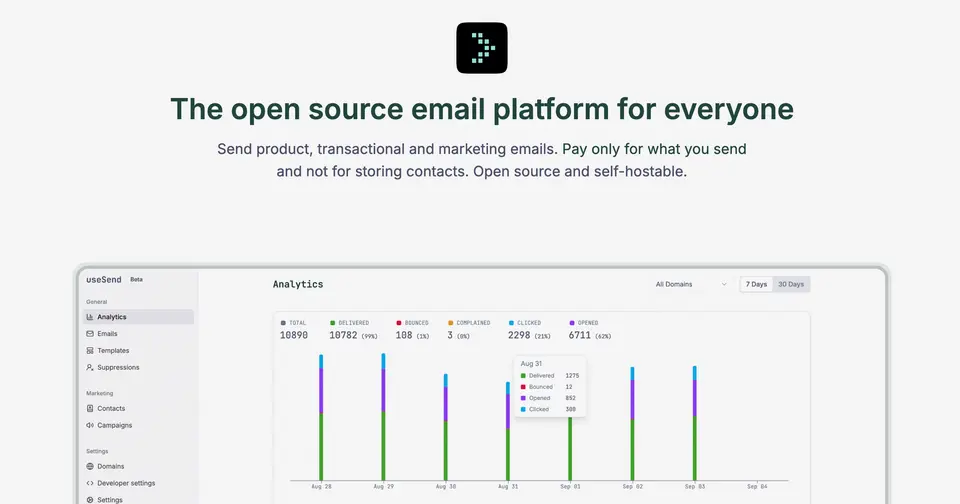
- A searchable log tracks deliveries, opens, clicks, bounces and unsubscribes, filterable by domain, status and API key, and exportable.
- Marketing editor and contacts
- A visual editor with templates and variables, plus contact lists with per-list subscription status that update from bounces and complaints.
- Suppression list
- Filled automatically from bounces and complaints and managed by import, export or API, for both transactional and marketing email.
useSend pricing
As of Nov 12, 2026, useSend has a free plan, and paid plans start at $10 per month, then pay as you go.
- Starts at
- $10 per month, then pay as you go
- Free plan
- Self-host edition: free to run on your own server and your own AWS account; you pay AWS directly, about $0.10 per 1,000 emails.
- Free trial
- None listed
| Plan | Price | What you get |
|---|---|---|
| Self-host | $0 | Open source and free forever; you host it yourself with Docker or Railway and pay AWS about $0.10 per 1,000 emails. Unlimited domains, contact books and team members. |
| Cloud | $10per month, then pay as you go | Includes 25,000 transactional or 10,000 marketing emails a month, then $0.40 per 1,000 transactional and $1 per 1,000 marketing. Unlimited domains and contact books. |
Read from usesend.com on Nov 12, 2026. Prices change, so confirm with useSend before you buy.
Works with
- Amazon SES
- Supabase
- Railway
- Docker
useSend alternatives
- useSend vs Amazon SES
Free trial
- useSend vs Resend
Free plan · from $20/mo
- useSend vs Postmark
Free plan · from $15/mo
- useSend vs MailPace
Free trial · from $10/mo
- useSend vs SendLayer
Free trial · from $5/mo





Common questions
Does useSend have an Android app?
No Android app was listed when its pages were read on Nov 12, 2026. useSend is listed for Web.
Does useSend have an iPhone app?
No iPhone app was listed when its pages were read on Nov 12, 2026. useSend is listed for Web.
Is useSend open source?
Yes. useSend is open source, according to its own site. It can also be run on a server of your own.
Does useSend have an API?
Yes. useSend offers a public API, according to its own site.
Sources for this page
The prices, plans, platforms and features above were read from these pages on Nov 12, 2026.