
ResearchRabbit review (2026): is the free plan enough?
Literature discovery tool that maps how papers connect
Black Friday: is there a ResearchRabbit sale?
ResearchRabbit report card
Fair · out of 4.0 · graded Oct 10, 2026
Best for free citation chasing from papers you know
ResearchRabbit finds similar, earlier and later work from a few papers you feed it and draws the connections as a map, and the free tier has no cap on searches or collections. It recommends by citation links rather than a language model, so it won't summarize or answer questions. Searches stop at 50 seed articles unless you pay $10 a month, papers without open-access metadata are missing, and it's web only.
Who ResearchRabbit is for
- Fits if you're starting a literature review from a few key papers
- Works for people who'd rather see a field as a map of connected papers and authors
Who ResearchRabbit is not for
- Skip it if you want AI summaries or answers, as it says its core algorithms don't use large language models
- Tight if your review starts from more than 50 seed articles, since 300 needs ResearchRabbit+ at $10 a month
- Watch out: advanced filters, multiple projects and Signals badges are RR+ only, and monthly billing is $12.50
- Watch out: articles without open-access metadata aren't indexed, so some papers and citations can be missing
- Not for you if you want a phone app or an API, as it's a web tool only
Why ResearchRabbit gets a 2.2
Five grades, each with its reason. The GPA is their average: an A is 4 points, an F is none.
- CValue for moneyResearchRabbit+ is $10 a month on the annual plan and $12.50 month to month, which is this category's middle. It lifts a search from 50 seed articles to 300 and adds advanced filters, multiple projects and Signals badges. The free tier covers enough that plenty won't need it.
- BFree plan and trialFree forever: unlimited searches across 310+ million articles, an unlimited library and collections, sharing and Zotero import. One person could live on this. The cap is 50 seed articles per search, and filters, multiple projects and Signals badges sit behind RR+.
- CFeaturesIt does citation chasing fully: similar, earlier and later work from your seed papers, maps of papers and authors, collections with notes you can share by link. That's a narrower job than the AI workspaces here, with no summaries, answers or writing. Articles without open-access metadata aren't indexed either.
- CEase of useNo store rating on record, and it does nothing until you feed it: you need a few papers you already trust, and then a willingness to read a citation map rather than a list. Your Zotero library comes across with the importer, at least.
- CPlatforms and integrationsWeb only, with no phone or desktop app and no API on the listing. The Zotero Importer brings in your saved papers, BibTeX goes in and out, and institutions can link their library through LibKey.
What these grades rest on. Graded from this listing, whose facts were read from ResearchRabbit's own pages on 9 October 2026. Also tested with a demo account on 2026-06-14. How we review and grade.
Make ResearchRabbit? Put this grade on your site
Paste this where you want the badge. It links here and follows the grade if it changes. About badges
<a href="https://toolgpa.com/tools/researchrabbit#review"><img src="https://toolgpa.com/badge/researchrabbit.svg" alt="ResearchRabbit: 2.2 GPA on ToolGPA" width="196" height="56"></a>Where ResearchRabbit stands among AI research tools
ResearchRabbit's GPA of 2.2 is higher than 16 of the 69 other AI research tools we grade, and level with 14.
It stands best on free plan and trial (B, above 49 of 69) and worst on platforms and integrations (C, above 0).
Its paid plans start at $10 a month, against a middle price of $10 for the category: 19 of the 48 others that charge start lower.
On features, ease of use and platforms it scores 2.0 out of 4. 22 tools score higher and cost less.
Each grade against the category
Every bar is all 70 AI research tools we grade, cut by the letter each got. ResearchRabbit’s own letter is outlined.
- CValue for moneyAbove 10 of 69, level with 37
- BFree plan and trialAbove 49 of 69, level with 11
- CFeaturesAbove 1 of 69, level with 51
- CEase of useAbove 1 of 69, level with 40
- CPlatforms and integrationsAbove 0 of 69, level with 27
Price against what you get
Each dot is one of 59 AI research tools. Further left costs less, and higher up scores better on features, ease of use and platforms. Point at a dot to see which tool it is.
Features, ease of use and platforms, averaged
What paid plans start at, a month (each step along is roughly double) →
- The best score at each price
- Has a free plan
- No free plan
Keep ResearchRabbit, or make your own?
Keep it
To replace ResearchRabbit you would be making a library of papers and sources to search. That is not a weekend's work, with an AI app builder or without one.
That makes this kind of software worth paying for, not this one in particular: 39 of the 69 other AI research tools grade higher. It costs $120 a year.
What you could not
- A library of papers and sources to search.
- Citation records for millions of papers.
- AI features, unless you pay a model provider for each request yourself.
- Sharing with other people, which means accounts and invitations.
What this rests on. ResearchRabbit’s listing: what it does, where it runs, what it plugs into and what it costs. It is a judgement about the kind of software this is. We have not built a replacement for it, and making your own means looking after it too. How we decide, and every tool’s verdict.
What is ResearchRabbit?
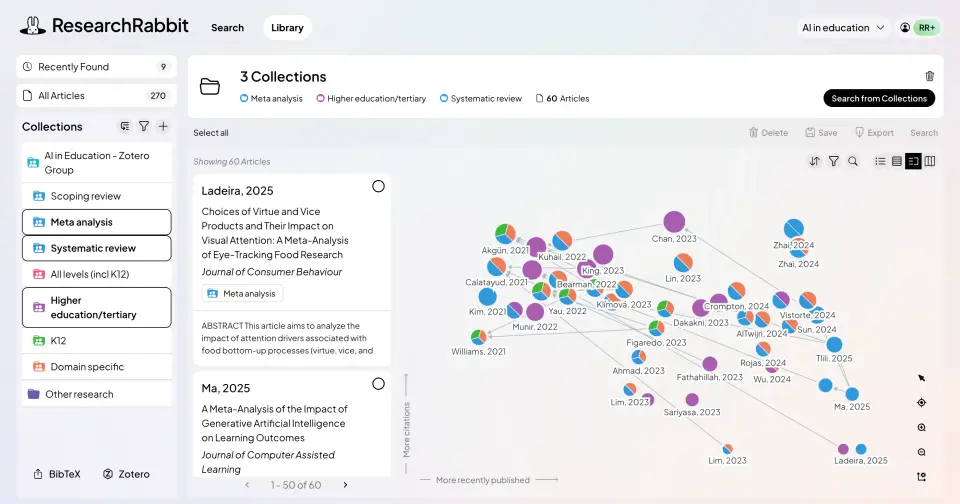
ResearchRabbit is a web tool for finding research papers by starting from ones you already know. You pick seed articles and it surfaces similar, earlier and later work from a database of more than 310 million articles, shown as lists and interactive citation maps. Papers are saved into shareable collections, and a paid tier called ResearchRabbit+ adds larger searches, advanced filters and multiple projects.
Worth knowing
- Free accounts can use up to 50 seed articles per search; RR+ raises that to 300.
- Advanced search filters, multiple projects and Signals badges are only in RR+.
- Recommendations rely on citation and authorship links; ResearchRabbit says its core algorithms do not use large language models.
- Articles without open-access metadata are not indexed, so some papers and citations can be missing.
Key features
- Seed-based paper search
- Start from one or more papers you already know and find similar, earlier and later work. Free accounts search from up to 50 seed articles and RR+ from up to 300.
- Citation maps
- Interactive maps show how papers and authors connect through citations and references, which helps in tracing how an idea developed.
- Collections
- Save papers to collections and subcollections, mark them with notes, stickers and colors, and share a collection with collaborators or through a public link.
- Zotero and BibTeX
- The Zotero Importer brings in papers saved in Zotero, and articles can be imported and exported as BibTeX files. Both are part of the free tier.
- Advanced search filters
- RR+ adds filters for keywords, publication date, journal quality, open access and retractions, plus separate projects for different papers.
- Signals risk badges
- In RR+, each article carries a Signals badge marking no major risks, caution, alert or unable to check. The full report needs a free Signals account.
ResearchRabbit pricing
As of Oct 9, 2026, ResearchRabbit has a free plan, and paid plans start at $10 per month on the annual plan ($12.50 on the monthly plan).
- Starts at
- $10 per month on the annual plan ($12.50 on the monthly plan)
- Free plan
- Free forever: unlimited searches across 310+ million articles, unlimited library and collections, shared collections, Zotero import, and searches from up to 50 seed articles.
- Free trial
- None listed
| Plan | Price | What you get |
|---|---|---|
| Free | $0 | Unlimited searches, library and collections, collection sharing, core search settings and up to 50 seed articles per search. |
| ResearchRabbit+ | $10per month on the annual plan; $12.50 on the monthly plan | Up to 300 seed articles, advanced search controls, multiple projects, Signals alerts and faster support responses. |
| Institution | Custom | Everything in RR+ with volume discounts, LibKey library integration, management of thousands of users, usage statistics and dedicated support. |
Read from researchrabbit.ai on Oct 9, 2026. Prices change, so confirm with ResearchRabbit before you buy.
Ways to pay less
- Annual discount20% off with the annual plan
RR+ is $10 a month on the annual plan against $12.50 on the monthly plan. The upgrade guide describes the annual option as 20% off.
Stated on learn.researchrabbit.ai - By countryCountry discounts in over 100 countries
RR+ is priced by purchasing-power group. People in more than 100 eligible countries are shown a discount to apply at checkout; the US, UK and Canada pay the default price.
Stated on learn.researchrabbit.ai
Works with
- Zotero
- LibKey
- Signals
ResearchRabbit alternatives
- ResearchRabbit vs Litmaps
Free plan · from $10/mo
- ResearchRabbit vs Connected Papers
Free plan · from $6/mo
- ResearchRabbit vs Scite
Free trial · from $20/mo





Common questions
Does ResearchRabbit have an Android app?
No Android app was listed when its pages were read on Oct 9, 2026. ResearchRabbit is listed for Web.
Does ResearchRabbit have an iPhone app?
No iPhone app was listed when its pages were read on Oct 9, 2026. ResearchRabbit is listed for Web.
Is ResearchRabbit open source?
ResearchRabbit is not described as open source on its own site, as read on Oct 9, 2026.
Sources for this page
The prices, plans, platforms and features above were read from these pages on Oct 9, 2026.
- researchrabbit.ai/pricing
- researchrabbit.ai
- researchrabbit.ai/features
- researchrabbit.ai/about-us
- researchrabbit.ai/help/guide
- learn.researchrabbit.ai/en/articles/12865509-researchrabbit-free-tier
- learn.researchrabbit.ai/en/articles/17309370-how-to-upgrade-to-researchrabbit-rr
- learn.researchrabbit.ai/en/articles/12454605-the-researchrabbit-database
- learn.researchrabbit.ai/en/articles/13545485-how-researchrabbit-uses-ai
- learn.researchrabbit.ai/en/articles/12874287-rr-country-discounts
- learn.researchrabbit.ai/en/articles/15888747-exploring-article-risk-with-signals-indicators