The Baserow Insider’s Guide
Everything we know about Baserow in one document: what it costs, its grades, getting a refund, getting help and what else to look at. Read it here, or keep a copy.
Baserow
The Insider’s Guide
Open-source no-code database and application builder
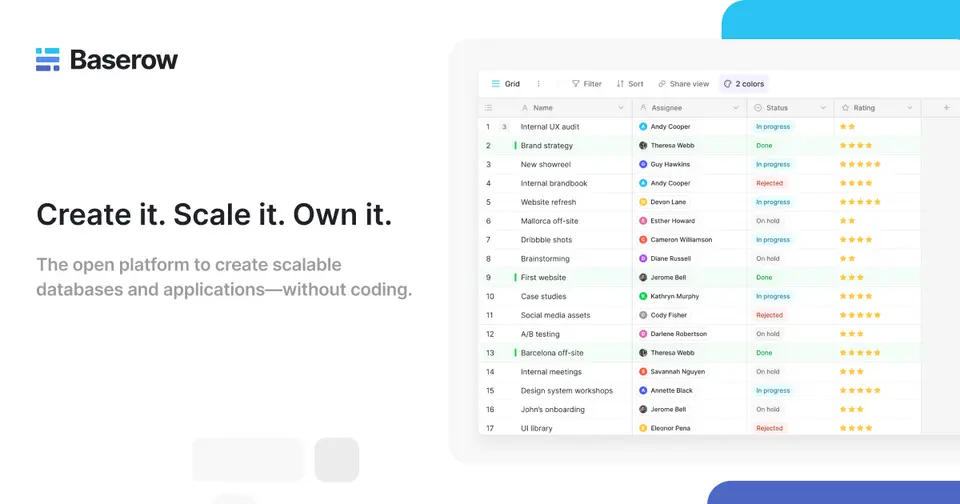
Every plan, grade, refund rule and rival among spreadsheet and database tools, read from Baserow’s own pages.
Made by Baserow B.V. · checked Oct 5, 2026 · toolgpa.com
Contents
- 01WelcomeWhat it is, who it suits, its grades and the ten things to know first
- 02What it costsEvery plan, the free plan, ways to pay less and how prices have moved
- 03What it doesIts main features, where it runs, what it works with and who makes it
- 04Where it standsIts grades against its category, and whether to keep it or make your own
- 05The alternativesThe tools it is most often weighed against, side by side
- 06Quick answersThe questions people ask about it, each answered in a line or two
- 07About ToolGPAWho made this guide, what else is on the site, and how to cite it
ToolGPA put this guide together from Baserow’s own pages, its app-store listings and our grades. Every fact in it is on Baserow’s page too, where it is kept up to date. Checked Oct 5, 2026.
Part 01 · Overview
Welcome
What it is, who it suits, its grades and the ten things to know first
2.6
GPA, above 8 of the 21 other spreadsheet and database tools we grade
Baserow is a no-code platform for building relational databases with a spreadsheet-like interface, then adding applications, automations and dashboards on top of the data. It is offered as a hosted cloud service and as a self-hosted version whose code is mostly MIT licensed. The vendor positions it as an open-source alternative to Airtable.
To get you started, here are 9 things to know about Baserow, taken from its own pages and our grades.
Self-hosted, it has no limits on rows, storage or API requests, but you run the server.
- 1
Best for an Airtable-style database you can host yourself
Baserow is a database that looks like a spreadsheet, with an app builder, automations and dashboards on top.
- 2
Paid plans start at $10 a month for each person
As its pricing page puts it: $10 per user / month, billed yearly.
- 3
There is a free plan
Free plan on Baserow Cloud: 3,000 rows and 2 GB of storage per workspace, 2,000 automation credits a month and 3 view types. The self-hosted version has no row or storage limits.
- 4
It runs on Web
Web.
- 5
Relational databases and views
Tables link to one another and offer more than 20 field types. Grid, Form and Gallery views are free; Kanban, Calendar, Timeline and Survey views need a paid plan.
- 6
Application Builder
A drag-and-drop builder for internal tools, client portals and admin panels that sit on Baserow data, published on a Baserow subdomain or a custom domain.
- 7
Automations
No-code workflows with triggers, branches, conditions and loops, native HTTP, email and webhook actions, and third-party connectors. Runs draw on a monthly credit allowance.
- 8
A 2.6 GPA, above 8 of 21
That is against the other spreadsheet and database tools we grade, on value, the free plan, features, ease of use and platforms.
- 9
Keep it
To replace Baserow you would be making a builder that other people can use without writing code. That is not a weekend's work, with an AI app builder or without one.
Baserow at a glance
- Pricing
- Free plan, from $10 per user / month, billed yearly
- Free plan
- Yes
- Free trial
- Free trial of the Advanced plan; the pricing page does not state its length
- Runs on
- Web
- Made by
- Baserow B.V., since 2020
- Category
- Spreadsheets & Databases
- Our grade
- 2.6 GPA, good
The report card
Best for an Airtable-style database you can host yourself
Baserow is a database that looks like a spreadsheet, with an app builder, automations and dashboards on top. Self-hosted, it has no limits on rows, storage or API requests, but you run the server. On Baserow Cloud the free plan stops at 3,000 rows and three view types, permissions and SSO need Advanced at $18 a user, and it only lives in a browser.
| Subject | Grade | Comment |
|---|---|---|
| Value for money | C | Premium is $10 a user a month billed yearly, $12 monthly, and the middle price in this category is $9.99, so it's the ordinary rate. That buys 50,000 rows, all the views and the AI features. Role-based permissions, audit logs and single sign-on wait for Advanced at $18. |
| Free plan and trial | B | Hosted free is capped at 3,000 rows and 2 GB per workspace, with 2,000 automation credits and only Grid, Form and Gallery views. Self-hosting is free with no row, storage or API limits, if you run the server yourself. |
| Features | B | It covers the whole no-code database job: linked tables with over 20 field types, Grid, Form, Gallery, Kanban, Calendar, Timeline and Survey views, an Application Builder for portals and internal tools, automations with branches and loops, an assistant that drafts a database from a description, and an open API. |
| Ease of use | C | No rating on record, and the work here is building the thing itself: tables, fields, views and permissions before anybody can use it. Kuma drafts a first database from a description, and self-hosting adds Docker, Helm, AWS or Cloudron on top. |
| Platforms and integrations | B | A browser and nothing else, with no desktop or phone apps listed, so an A is out. What it does have is connections: Zapier, n8n, Make, Slack, Jira, GitHub and HubSpot, an open API with a published OpenAPI spec, and webhooks. The cloud API allows 10 concurrent requests. |
An A is worth 4 points, a B 3, a C 2, a D 1 and an F nothing. The GPA is the average of the five.
Who Baserow is for
- Fits if you want an Airtable-style database on your own server, with no row or storage limits
- Works for organisations with data residency rules who can run it in-house
Who it is not for
- Tight if you're staying free on the cloud, where new rows are blocked after 7 days over the 3,000 cap
- Skip it if you want a phone app for looking things up, as it's web only
- Pricey if you need role-based permissions, audit logs or single sign-on, which start at $18 a user a month
- Too light for free users who want Kanban, Calendar or Timeline views or row comments, which need Premium
- Watch out: the cloud API allows 10 concurrent requests, and the Advanced trial's length isn't published
Good to know
Good for
- Teams that want an Airtable-style database they can host themselves
- Building internal tools and portals on top of structured data
- Organizations with data residency or compliance requirements
Worth knowing
- Cloud plans cap rows per workspace at 3,000 on Free, 50,000 on Premium and 250,000 on Advanced; after 7 days over the cap, new rows are blocked.
- The Free plan is limited to Grid, Form and Gallery views and CSV export; Kanban, Calendar and Timeline views and row comments need Premium.
- Role-based permissions, audit logs and single sign-on start at the Advanced plan, $18 per user / month billed yearly.
- Baserow Cloud limits the API to 10 concurrent requests; the self-hosted version has no rate limit.
Part 02 · Pricing
What it costs
Every plan, the free plan, ways to pay less and how prices have moved
$10
A month to start, for each person. There is a free plan too
Baserow has a free plan. Paid plans start at $10 per user / month, billed yearly.
Self-hosting is free with no row, storage or API limits, if you run the server yourself.
Free
$0
3,000 rows and 2 GB of storage per workspace, 2,000 automation credits, 500 external app users, and Grid, Form and Gallery views.
Premium
$10
per user / month, billed yearly ($12 billed monthly)
50,000 rows and 20 GB per workspace, 100,000 automation credits, all view types and AI features.
Advanced
$18
per user / month, billed yearly ($22 billed monthly)
250,000 rows and 100 GB per workspace, 500,000 automation credits, role-based permissions and audit logs.
Enterprise
Custom
1,000,000 rows and 1,000 GB per workspace, unlimited external app users, implementation support and payment by invoice.
The free plan
Free plan on Baserow Cloud: 3,000 rows and 2 GB of storage per workspace, 2,000 automation credits a month and 3 view types. The self-hosted version has no row or storage limits.
Trying it first
Free trial of the Advanced plan; the pricing page does not state its length
Read from baserow.io on Oct 5, 2026.
Ways to pay less
Annual discount
Lower rates with yearly billing
Premium is $10 per user a month billed yearly against $12 billed monthly, and Advanced is $18 against $22, a saving of roughly 17% to 18%.
Stated on baserow.ioNonprofit
Discounts for non-profits
Baserow's pricing FAQ says it offers discounts for non-profits. The amount is not published and is arranged through the sales team.
Stated on baserow.ioEducation
Discounts for education
The same FAQ says discounts are available for education. The amount is not published and is arranged through the sales team.
Stated on baserow.io
Part 03 · Features
What it does
Its main features, where it runs, what it works with and who makes it
1
Place it runs: Web
Open-source no-code database and application builder. Here is what it does, as its own site describes it, and what it covers: open source, self-hostable, public API, databases, workflow automation, app builder, no-code.
A browser and nothing else, with no desktop or phone apps listed, so an A is out.
- Relational databases and views
- Tables link to one another and offer more than 20 field types. Grid, Form and Gallery views are free; Kanban, Calendar, Timeline and Survey views need a paid plan.
- Application Builder
- A drag-and-drop builder for internal tools, client portals and admin panels that sit on Baserow data, published on a Baserow subdomain or a custom domain.
- Automations
- No-code workflows with triggers, branches, conditions and loops, native HTTP, email and webhook actions, and third-party connectors. Runs draw on a monthly credit allowance.
- Kuma and AI fields
- Kuma, the built-in assistant, sets up databases and applications from a description, and the AI field creates, classifies and enriches data. Teams can bring their own LLM.
- Self-hosting
- Baserow can be installed with Docker, Helm, AWS or Cloudron. The self-hosted version has no limits on rows, storage or API requests, and paid features are licensed per user.
- API and data sync
- An open API with a published OpenAPI specification, plus webhooks. Data sync covers PostgreSQL tables and iCal feeds; Jira, GitLab, GitHub and HubSpot sync is part of the Advanced plan.
Where it runs
- Web
What it works with
- Zapier
- n8n
- Make
- Slack
- Jira
- GitHub
- GitLab
- HubSpot
Baserow is made by Baserow B.V., and has been around since 2020.
Part 04 · Standing
Where it stands
Its grades against its category, and whether to keep it or make your own
8/21
Other spreadsheet and database tools it is graded above
Baserow's GPA of 2.6 is higher than 8 of the 21 other spreadsheet and database tools we grade, and level with 4.
It stands best on free plan and trial (B, above 8 of 21) and worst on ease of use (C, above 0).
Its paid plans start at $10 a month for each person, against a middle price of $8 for the category: 13 of the 20 others that charge start lower.
On features, ease of use and platforms it scores 2.7 out of 4. 5 tools score higher and cost less.
Each grade against the category
Every bar is all 22 spreadsheet and database tools we grade, cut by the letter each got. Baserow’s own letter is outlined.
- CValue for moneyAbove 4 of 21
- BFree plan and trialAbove 8 of 21
- BFeaturesAbove 6 of 21
- CEase of useAbove 0 of 21
- BPlatforms and integrationsAbove 3 of 21
Price against what you get
Each dot is one of 22 spreadsheet and database tools. Further left costs less; higher up scores better on features, ease of use and platforms. Baserow is the marked dot.
What paid plans start at, a month (each step along is roughly double) →
Keep it, or make your own?
Whether this is something you could build for yourself with an AI app builder, and what you would give up.
Keep it
To replace Baserow you would be making a builder that other people can use without writing code. That is not a weekend's work, with an AI app builder or without one.
It costs $120 a year. Baserow is open source, so there is a third way: take its code and run it yourself.
What you could not
- A builder that other people can use without writing code.
- A tool that builds and hosts other apps.
- Connections to other products, each kept working as those products change.
- Databases with views, filters and links between them.
- It is priced for each person, which means accounts and billing for a team.
- The depth: we grade its features B, which means it covers the whole job.
What this rests on. Baserow’s listing: what it does, where it runs, what it plugs into and what it costs. It is a judgement about the kind of software this is. We have not built a replacement for it, and making your own means looking after it too. How we decide, and every tool’s verdict.
Part 05 · Alternatives
The alternatives
The tools it is most often weighed against, side by side





NocoDB, Grist, Airtable, SeaTable and Teable
The 5 tools Baserow is most often weighed against, with where each one differs from it.
- 2.6GPA
NocoDB
Free plan · from $12/mo
No-code database with a spreadsheet interface, cloud or self-hosted.
- Baserow is open source, according to its own site.
- Baserow also covers app builder.
- NocoDB also covers kanban boards and forms.
- 2.6GPA
Grist
Free plan · from $8/mo
Open-source relational spreadsheet with Python formulas.
- Only Grist lists Windows, macOS and Linux apps.
- Baserow also covers workflow automation, app builder and no-code.
- Grist also covers spreadsheets.
- 3.0GPA
Airtable
Free plan · from $20/mo
Relational database platform for building team workflows and apps.
- Only Airtable lists macOS, Windows, iOS and Android apps.
- Baserow is open source and self-hostable, according to its own site.
- Baserow also covers app builder and no-code.
- 2.6GPA
SeaTable
Free plan · from €7/mo
No-code database and app builder, in the cloud or self-hosted.
- Only SeaTable lists an Android app.
- Baserow is open source, according to its own site.
- 2.6GPA
Teable
Free plan · from $13/mo
Part 06 · Questions
Quick answers
The questions people ask about it, each answered in a line or two
16
Questions, each answered in a line or two
The short version of everything above, for when you only need the answer. Each one is told in full in its part of the guide.
Is Baserow free?
Baserow has a free plan. Free plan on Baserow Cloud: 3,000 rows and 2 GB of storage per workspace, 2,000 automation credits a month and 3 view types.
How much does Baserow cost?
Baserow lists 4 plans. Free: $0.
What platforms does Baserow work on?
Baserow is available on Web.
Does Baserow offer any discounts?
Baserow publicly lists the following: Lower rates with yearly billing; Discounts for non-profits; Discounts for education.
Does Baserow have an Android app?
No Android app was listed when its pages were read on Oct 5, 2026. Baserow is listed for Web.
Does Baserow have an iPhone app?
No iPhone app was listed when its pages were read on Oct 5, 2026. Baserow is listed for Web.
Is Baserow open source?
Yes. Baserow is open source, according to its own site.
Does Baserow have an API?
Yes. Baserow offers a public API, according to its own site.
What does Baserow integrate with?
Baserow's listing names Zapier, n8n, Make, Slack, Jira, GitHub, GitLab and HubSpot.
Does Baserow have a student discount?
Discounts for education. The same FAQ says discounts are available for education.
Does Baserow have a free trial?
Yes. Free trial of the Advanced plan; the pricing page does not state its length.
Who makes Baserow?
Baserow is made by Baserow B.V. It dates from 2020.
What are the alternatives to Baserow?
The closest alternatives to Baserow in our directory are NocoDB, Grist, Airtable, SeaTable and Teable.
How does Baserow compare with other spreadsheet and database tools?
Baserow's GPA of 2.6 is higher than 8 of the 21 other spreadsheet and database tools we grade, and level with 4.
Is Baserow good value for money?
ToolGPA grades Baserow C for value for money. Its paid plans start at $10 a month for each person, against a middle price of $8 for the category: 13 of the 20 others that charge start lower.
Could I make my own version of Baserow?
To replace Baserow you would be making a builder that other people can use without writing code.
Where this guide comes from
The prices, plans, platforms and features were read from Baserow’s own pages on Oct 5, 2026, and the grades were given on Oct 10, 2026. Graded from this listing, whose facts were read from Baserow's own pages on 5 October 2026. Also tested with a demo account on 2026-08-08.
Every tool we list gets five grades, A to F, each with its reason, and a GPA that averages them. How each is decided is at toolgpa.com/grades. This guide is ToolGPA’s own work; it is not made, paid for or approved by Baserow B.V. Prices change, so check baserow.io before you buy.
Part 07 · About
About ToolGPA
Who made this guide, what else is on the site, and how to cite it
3,189
Tools graded, in 94 categories
ToolGPA grades software the way a school report grades a pupil: five subjects, a letter for each with the reason written beside it, and a GPA that averages them. Prices, plans and platforms are read from each maker’s own pages and dated, so you always know how fresh a figure is.
Every grade, review and ranking on ToolGPA is our own judgement. No company can pay for a grade or change one. Every tool on the site has a guide like this one, free to download and pass on. It all lives at toolgpa.com.
3,189
tools graded
94
categories
426
price changes on record
579
apps priced in 12 countries
What else is on toolgpa.com
- Baserow, kept up to dateEverything in this guide, with prices and grades as they are todaytoolgpa.com/tools/baserow
- How grades are givenThe rules behind every letter and every GPAtoolgpa.com/grades
- Value chartsWhat each tool costs against what it scores, for every categorytoolgpa.com/charts
- CompareAny two tools side by side, plan by plantoolgpa.com/compare
- Price changesEvery price rise and cut on record, each with its sourcetoolgpa.com/price-changes
- Prices by countryWhat apps cost on the App Store in 12 countriestoolgpa.com/prices-by-country
- Pay lessEvery public discount: yearly billing, students, nonprofitstoolgpa.com/save
- Keep or makeWhich tools are worth paying for, and which you could build yourselftoolgpa.com/keep-or-make
Scan for the live page
Prices and grades as they are today
Quoting this guide?
Please name ToolGPA and link to the live page, so readers can check the figures for themselves:
ToolGPA, "Baserow: The Insider's Guide", checked Oct 5, 2026. https://toolgpa.com/tools/baserow
Know someone choosing between spreadsheet and database tools?
Send them this guide: toolgpa.com/tools/baserow/guide
ToolGPA elsewhere: youtube.com/@toolgpa
See our other guides
The best-graded spreadsheet and database tools after Baserow, each with an Insider's Guide of its own.
- Spreadsheets & Databases Insider's GuideEvery one of the 22 spreadsheet and database tools we grade, compared
- Zoho Sheet Insider's GuideCollaborative online spreadsheet with a free version3.6 GPA
- Google Sheets Insider's GuideBrowser-based spreadsheet, free with a Google Account3.4 GPA
- Microsoft Excel Insider's GuideSpreadsheet app sold with Microsoft 365, free in the browser3.4 GPA

Choosing software? Every tool graded, every price dated.
Compare tools at toolgpa.com ›Everything in this guide is ToolGPA’s own summary of what Baserow’s pages, its app-store listings and public reviews said on the dates shown. Grades are our judgement under the rules at toolgpa.com/grades. Every grade, review and ranking on ToolGPA is our own judgement. No company can pay for a grade or change one. Baserow is a trademark of its owner, and this guide is not made, paid for or approved by Baserow B.V. Prices and plans change: check baserow.io before you buy.