
Zanda review (2026): is it worth $19 a month?
Browser-based practice software for allied health and therapy clinics
Our verdict
Third of our top three therapy and clinic software
For: Clinics with several practitioners and rooms
Zanda runs scheduling with waitlists and rooms, a client booking portal, notes and body charts, scored forms, invoicing, US claims through a clearing house and telehealth. Starter is $19 a month for one practitioner and 1,000 appointments; Growth is $49 plus $19 per extra practitioner, with more locations. It is third because there is no app for any device, only the browser, AI scribing stops at 4 sessions a month without AI Pro at $19 a user, texts need a $4.99 number plus 9¢ each past 35, and claims carry a $50 enrollment fee and 15¢ a claim.
See all three and how we rankZanda report card
Good · out of 4.0 · graded Oct 24, 2026
Best for allied health and therapy clinics in the browser
Zanda runs scheduling, a client portal, notes, invoicing, US claims and telehealth in the browser, from $19 a month for one practitioner. There's no mobile app, texts need a $4.99 number plus 9¢ a message past 35, and unlimited AI scribing, more locations and a second practitioner all cost extra.
Who Zanda is for
- Fits if you're a solo practitioner who wants unlimited clients for $19 a month
- Works for allied health and mental health clinics juggling several practitioners and rooms
Who Zanda is not for
- Skip it if you want a phone app, as Zanda runs only in the browser
- Tight if you stay on Starter: one practitioner, one location and 1,000 appointments; more needs Growth at $49
- Watch out: texts need a dedicated number at $4.99 a month with 35 credits, then 9¢ an SMS
- Pricey if you scribe every session: 4 AI Scribe sessions a month are free, then AI Pro is $19 a user, Telehealth Pro $9
- Watch out: claims carry a $50 enrollment fee, 15¢ a claim and 10¢ an ERA, and Stripe takes 2.9% + 30¢ plus 50¢
Why Zanda gets a 2.6
Five grades, each with its reason. The GPA is their average: an A is 4 points, an F is none.
- BValue for moneyStarter is $19 a month for one practitioner with unlimited clients and 1,000 appointments, inside this category's cheaper quarter ($25). Five practitioners on Growth come to $125, or $25 each. Texts, AI Pro and Telehealth Pro are extra.
- CFree plan and trialA 14-day trial with no card needed, and no free plan, so you're paying from week three.
- BFeaturesScheduling with waitlists and rooms, a booking portal, note templates, body charts, scored forms, invoicing, US claims through a clearing house, telehealth and BizzyAI writing. AI scribing stops at 4 sessions a month without AI Pro.
- CEase of useNo App Store rating on record. Rooms, locations, note templates, forms and the clearing house enrollment all need setting up first.
- BPlatforms and integrationsIt runs in the browser on computers, tablets and phones, with Stripe, Zoom, Xero, Mailchimp, Google Calendar and Outlook. There are no native apps for any device.
What these grades rest on. Graded from this listing, whose facts were read from Zanda's own pages on 24 October 2026. Not based on using the product, and shorter than our full reviews. How we review and grade.
Make Zanda? Put this grade on your site

Paste this where you want the badge. It links here and follows the grade if it changes. About badges
<a href="https://toolgpa.com/tools/zanda#review"><img src="https://toolgpa.com/badge/zanda.svg" alt="Zanda: 2.6 GPA on ToolGPA" width="196" height="56"></a>Where Zanda stands among therapy and clinic software
Zanda's GPA of 2.6 is higher than 10 of the 12 other therapy and clinic software we grade, and level with 1.
It stands best on value for money (B, above 11 of 12) and worst on ease of use (C, above 0).
Its paid plans start at $19 a month, against a middle price of $39 for the category: 1 of the 10 others that charge start lower.
On features, ease of use and platforms it scores 2.7 out of 4. Nothing scores higher for less, though at least one tool matches that score at a lower price.
Each grade against the category
Every bar is all 13 therapy and clinic software we grade, cut by the letter each got. Zanda’s own letter is outlined.
- BValue for moneyAbove 11 of 12, level with 1
- CFree plan and trialAbove 2 of 12, level with 9
- BFeaturesAbove 1 of 12, level with 11
- CEase of useAbove 0 of 12, level with 11
- BPlatforms and integrationsAbove 3 of 12, level with 9
Price against what you get
Each dot is one of 11 therapy and clinic software. Further left costs less, and higher up scores better on features, ease of use and platforms. Point at a dot to see which tool it is.
Features, ease of use and platforms, averaged
What paid plans start at, a month (each step along is roughly double) →
- The best score at each price
- Has a free plan
- No free plan
Keep Zanda, or make your own?
Keep it
To replace Zanda you would be making video sessions that meet health privacy rules. That is not a weekend's work, with an AI app builder or without one.
It is one of the better ones too: its GPA of 2.6 is higher than 10 of the 12 other therapy and clinic software we grade. It costs $228 a year.
What you could make
- Appointment booking and clinical notes: an app builder makes these well.
What you could not
- Video sessions that meet health privacy rules.
- Insurance claims sent to payers through a clearinghouse.
- Speech turned into text you can trust.
- It plugs into other products, Stripe, Zoom and Xero among them.
- AI features, unless you pay a model provider for each request yourself.
- What a company asks for before it lets staff use something: HIPAA.
- The depth: we grade its features B, which means it covers the whole job.
What this rests on. Zanda’s listing: what it does, where it runs, what it plugs into and what it costs. It is a judgement about the kind of software this is. We have not built a replacement for it, and making your own means looking after it too. How we decide, and every tool’s verdict.
What is Zanda?
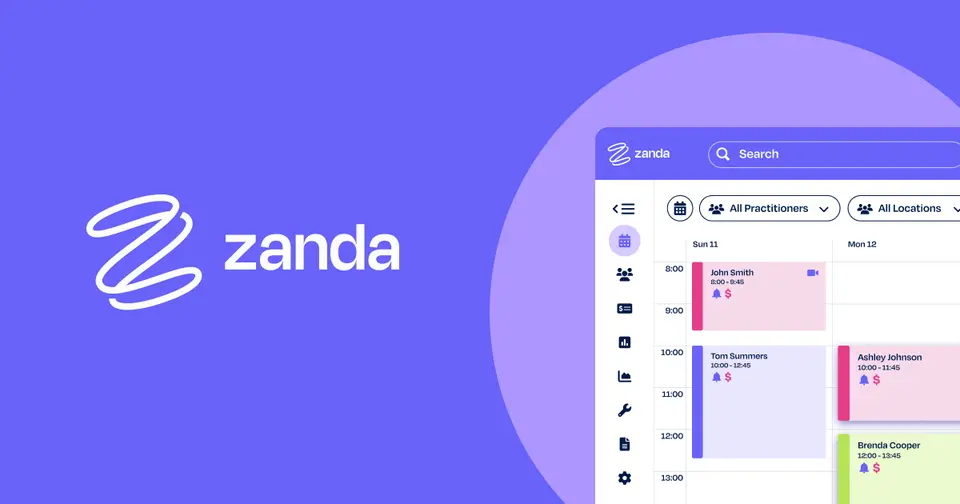
Zanda is cloud practice management software for psychologists, counselors, physiotherapists, speech pathologists and other health practitioners. It covers scheduling with waitlists and rooms, a client booking portal, session notes and forms, invoicing, insurance claims and telehealth, with BizzyAI writing and scribe tools built in. It runs in the browser rather than in apps.
Worth knowing
- Starter covers one practitioner and 1,000 appointments, with one physical location; unlimited appointments and more locations need Growth.
- Text messages need a dedicated number at $4.99 a month, which includes 35 credits; each further SMS costs $0.09.
- Card payments go through Stripe at 2.9% + 30¢ for domestic cards, plus a 50¢ Stripe Connect fee listed on the pricing page.
- There are no native mobile apps; Zanda runs in the browser on computers, tablets and phones.
Key features
- Scheduling and client portal
- A calendar with waitlists, rooms and recurring appointments, and a portal where clients book, pay, fill in forms, share files and join telehealth calls.
- Notes, forms and body charts
- Session note templates and body charts, plus online forms for intake, consent and scored assessments. Note templates can be customized on Growth.
- BizzyAI
- Every plan includes unlimited AI writing, 4 AI Scribe appointments a month and insights across a client's last 3 sessions. AI Pro, $19 per user a month, removes the scribe cap.
- Telehealth
- Built-in HIPAA-compliant video with a free option, Telehealth Pro with unlimited calls at $9 per practitioner a month, or your own Zoom account.
- US insurance claims
- An integrated clearing house with a $50 enrollment fee, $0.15 per claim and $0.10 per ERA. Preparing claims, CMS-1500 forms and eligibility requests are free.
- Practice operations manual
- 100+ policy and procedure templates for writing down how the practice runs, with AI tools for the manual on Growth.
Zanda pricing
As of Oct 24, 2026, Zanda is a paid product with a free trial, starting at $19 per month (Starter, one practitioner).
- Starts at
- $19 per month (Starter, one practitioner)
- Free plan
- None
- Free trial
- 14-day free trial, no credit card required
| Plan | Price | What you get |
|---|---|---|
| Starter | $19per month for 1 practitioner and 1,000 appointments | Unlimited clients, 1 free admin user, 100 GB storage, reminders, intake forms, progress notes, billing and the booking portal. $9.50 for the first 6 months. |
| Growth | $49per month, plus $19 per additional practitioner | Unlimited appointments, admin users and storage, multiple locations, rooms, advanced waitlist, custom note templates, team messaging and full reports. |
Read from zandahealth.com on Oct 24, 2026. Prices change, so confirm with Zanda before you buy.
Ways to pay less
- Other savings50% off the first 6 months for October starts
Practices that start in October pay half for 6 months: Starter $9.50 a month, and Growth $24.50 plus $9.50 per extra practitioner, then the regular price.
Stated on zandahealth.com - Other savingsNo subscription fees until November
An end-of-summer offer on the US pricing page waives subscription fees until November and adds 500 free SMS credits.
Stated on zandahealth.com
Works with
Zanda alternatives
- Zanda vs Cliniko
Free trial · from $45/mo
- Zanda vs Jane
From $59/mo
- Zanda vs SimplePractice
Free trial · from $49/mo
- Zanda vs Carepatron
Free plan · from $31/mo
- Zanda vs Owl Practice
Free trial · from $60/mo





Common questions
Does Zanda have an Android app?
No Android app was listed when its pages were read on Oct 24, 2026. Zanda is listed for Web.
Does Zanda have an iPhone app?
No iPhone app was listed when its pages were read on Oct 24, 2026. Zanda is listed for Web.
Is Zanda open source?
Zanda is not described as open source on its own site, as read on Oct 24, 2026.
Sources for this page
The prices, plans, platforms and features above were read from these pages on Oct 24, 2026.