
Form.io review (2026): is it worth $300 a month?
JSON form and API platform for developers, hosted or self-hosted
Black Friday: is there a Form.io sale?
Form.io report card
Weak · out of 4.0 · graded Nov 13, 2026
Best for engineering teams embedding forms in their own apps
Form.io builds forms from JSON and serves them through an API, either hosted on its portal or in Docker containers you run yourself. It is priced by project and environment rather than by usage, which puts it far above ordinary form builders.
Who Form.io is for
- Fits if your developers need forms inside your own application and its data
- Makes sense if you must host data in your own infrastructure
Who Form.io is not for
- Skip it if you want a free plan, because none exists
- Pricey if you only need a few forms: the lowest hosted plan is $300 a month
- Tight if you need several environments, since each needs its own server license
- Watch out: the hosted project may not collect personal or sensitive data
- Not for you if you want a no-code builder without developers
Why Form.io gets a 1.6
Five grades, each with its reason. The GPA is their average: an A is 4 points, an F is none.
- DValue for moneyThe hosted project is $300 a month and self-hosting starts at $660, against a forms middle of $20 and a dearest tenth from $66.
- CFree plan and trialA 30-day trial needs no card, but the project turns read-only afterward and it may not hold personal data.
- CFeaturesForms, API and PDF output are covered, but reporting, accessibility, multi-tenancy and the embedded builder are paid add-ons.
- DEase of useIt is built for developers: JSON definitions, and Docker containers and databases for the self-hosted route.
- CPlatforms and integrationsWeb only, with an API and an open-source JavaScript library, and no integrations list on record.
What these grades rest on. Graded from this listing, whose facts were read from Form.io's own pages on 13 November 2026. Not based on using the product, and shorter than our full reviews. How we review and grade.
Make Form.io? Put this grade on your site

Paste this where you want the badge. It links here and follows the grade if it changes. About badges
<a href="https://toolgpa.com/tools/form-io#review"><img src="https://toolgpa.com/badge/form-io.svg" alt="Form.io: 1.6 GPA on ToolGPA" width="196" height="56"></a>Where Form.io stands among form and survey tools
Form.io's GPA of 1.6 is higher than 0 of the 60 other form and survey tools we grade.
It stands best on free plan and trial (C, above 4 of 60) and worst on value for money (D, above 0).
Its paid plans start at $300 a month, against a middle price of $19.50 for the category: 50 of the 51 others that charge start lower.
On features, ease of use and platforms it scores 1.7 out of 4. 50 tools score higher and cost less.
Each grade against the category
Every bar is all 61 form and survey tools we grade, cut by the letter each got. Form.io’s own letter is outlined.
- DValue for moneyAbove 0 of 60, level with 11
- CFree plan and trialAbove 4 of 60, level with 38
- CFeaturesAbove 0 of 60, level with 31
- DEase of useAbove 0 of 60, level with 2
- CPlatforms and integrationsAbove 0 of 60, level with 11
Price against what you get
Each dot is one of 53 form and survey tools. Further left costs less, and higher up scores better on features, ease of use and platforms. Point at a dot to see which tool it is.
Features, ease of use and platforms, averaged
What paid plans start at, a month (each step along is roughly double) →
- The best score at each price
- Has a free plan
- No free plan
Keep Form.io, or make your own?
You could make this
A form at its plainest is questions, a button and a table of answers.
What Form.io does at its core is forms, and that is the kind of thing an AI app builder makes well. You would give up one thing, listed below, and little else. It costs $3,600 a year. An AI app builder starts at about $20 a month on our listings, and you only need it while you build. Form.io is open source, so there is a third way: take its code and run it yourself.
What you could make
- Forms: an app builder makes this well.
- It runs in a browser, which is where something home-made would run too.
What you could not
- An API that other software can build on.
What this rests on. Form.io’s listing: what it does, where it runs, what it plugs into and what it costs. It is a judgement about the kind of software this is. We have not built a replacement for it, and making your own means looking after it too. How we decide, and every tool’s verdict.
What is Form.io?
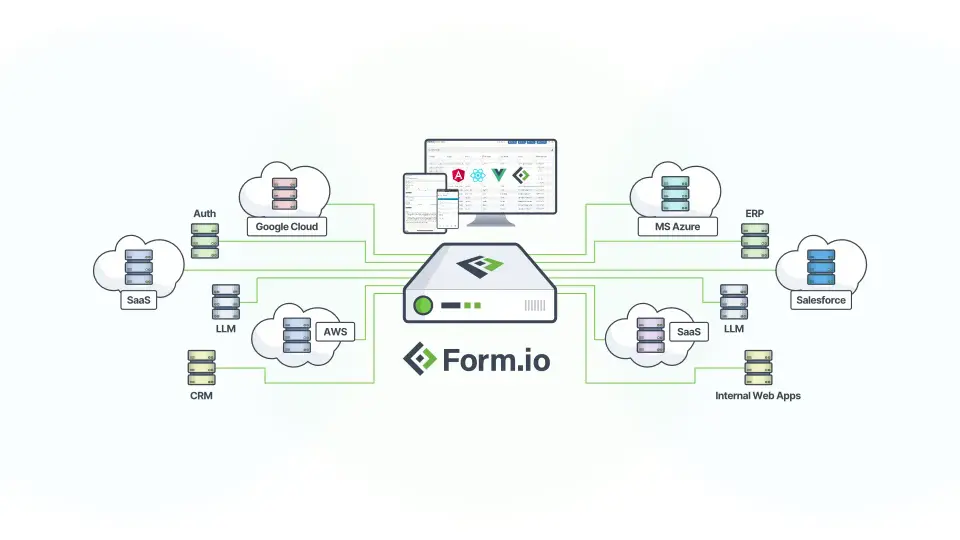
Form.io is a platform for building forms and the APIs behind them, driven by JSON form definitions. It is sold as Docker containers that a customer runs in its own environments and databases, plus a hosted SaaS project on portal.form.io. Pricing is by project and environment, not by submissions or users.
Worth knowing
- There is no free plan; the hosted SaaS project is $300 a month after the 30-day trial, and the self-hosted options start higher.
- Self-hosted minimum is one project plus one API server environment, $660 a month; each extra environment needs its own server license.
- The SaaS project must not hold personal or sensitive data, per the pricing page, and lacks some security features.
- Add-ons per month: Reporting UI $660, accessibility $495, multi-tenancy $330, embedded builder $660. Five developer licenses are $2,640 a year.
Key features
- JSON-driven forms
- Forms are defined in JSON, rendered by the open-source formio.js library and stored through the platform's API.
- Self-hosted containers
- The platform ships as Docker containers that run in the customer's own environments and databases.
- PDF forms
- Optional PDF servers display PDF forms and export submissions to PDF.
- Multi-tenancy and embedded builder
- Paid add-ons support tenant-separated forms and data, and an embedded form builder inside your own application.
- Security options
- API Plus adds audit logging, field-level encryption and data separation for compliance needs.
Form.io pricing
As of Nov 13, 2026, Form.io is a paid product with a free trial, starting at $300 per month, hosted SaaS project; self-hosted from $660 per month.
- Starts at
- $300 per month, hosted SaaS project; self-hosted from $660 per month
- Free plan
- None
- Free trial
- 30-day free trial of the hosted SaaS project, no credit card; the project turns read-only afterward
| Plan | Price | What you get |
|---|---|---|
| SaaS Enterprise Project | $300per month, hosted on portal.form.io | One project with unlimited forms and developers, 1M submissions a month, 25 PDF-first forms and 1,000 PDF downloads. No PII; some security features missing. |
| Enterprise Level Project | $330per month per project; at least one required | Unlimited forms, resources, developers, form builders and submissions, with a self-hosted developer portal. |
| API Server | $330per month per environment | One server environment with unlimited API calls and submissions. An API Server or API Plus Server is required for each environment. |
| API Plus Server | $660per month per environment | Adds audit logging, submission data separation, field-level encryption and container security scanning. |
| PDF Server | $330per month per environment | Optional. Unlimited PDF submission downloads. The PDF Plus Server is $660 per month and adds uploads and a template designer. |
Read from form.io on Nov 13, 2026. Prices change, so confirm with Form.io before you buy.
Form.io alternatives
- Form.io vs Formstack
Free trial · from $83/mo
- Form.io vs Jotform
Free plan · from $34/mo
- Form.io vs Formaloo
Free plan · from $19/mo





Common questions
Does Form.io have an Android app?
No Android app was listed when its pages were read on Nov 13, 2026. Form.io is listed for Web.
Does Form.io have an iPhone app?
No iPhone app was listed when its pages were read on Nov 13, 2026. Form.io is listed for Web.
Is Form.io open source?
Yes. Form.io is open source, according to its own site. It can also be run on a server of your own.
Does Form.io have an API?
Yes. Form.io offers a public API, according to its own site.
Sources for this page
The prices, plans, platforms and features above were read from these pages on Nov 13, 2026.