
Marco review (2026): is it any good?
Free, offline-first email client for Mac, iPhone and web
Marco report card
Good · out of 4.0 · graded Oct 10, 2026
Best for free offline email with no AI in it
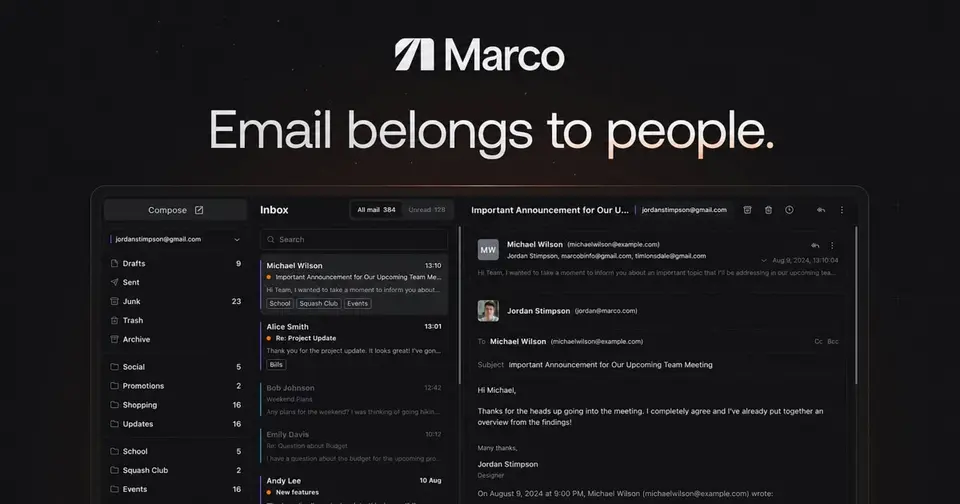
Marco is a free email app for Mac, iPhone and the web that takes all your accounts into one inbox and keeps working with no internet. It leaves out AI on purpose, so nothing drafts, sums up or replies for you. The feature list is short, with no calendar, snooze or send later on record, there are no Windows or Android apps yet, and the Pro plan with custom domains and team features is still marked Coming Soon with no price.
Who Marco is for
- Fits if you want an email app that doesn't write or summarize your messages for you
- Works for people who need their mail on a plane with no connection
Who Marco is not for
- Skip it if you're on Windows or Android, as those apps are only on the roadmap
- Not for you if you want AI drafts or summaries, because it leaves them out on purpose
- Too light for teams, since team collaboration sits in a Pro plan that's still Coming Soon
- Not for you if you need snooze, send later or a calendar, as none is on record
- Watch out: custom domains, priority support and API access wait for the unpriced Pro plan
Why Marco gets a 2.8
Five grades, each with its reason. The GPA is their average: an A is 4 points, an F is none.
- AValue for moneyIt's free: unlimited email accounts, offline access, sync across devices, search, and custom labels and filters, all at $0 with no payment method needed. A Pro plan is marked Coming Soon with no price.
- AFree plan and trialFree forever with no credit card, and nothing is held back: unlimited email accounts, offline access, cross-platform sync, search, labels and filters. There's no paid plan to buy yet.
- CFeaturesThe basics, and that's where the list stops: one inbox for Gmail, Outlook, Yahoo, iCloud and any IMAP account, mail synced to the device for offline use, search, labels and filters. No AI by design, and no calendar, snooze or send later on record either.
- CEase of useNo rating on record. There's little to it, but you're still connecting each account yourself, and with no AI and a short feature list there's nothing to guide you once you're in.
- CPlatforms and integrationsApple and a browser: Mac, iPhone and iPad apps plus a web version, with sync between them. No Windows or Android apps, though the FAQ puts both on the roadmap, and API access sits in the Pro plan that isn't out yet.
What these grades rest on. Graded from this listing, whose facts were read from Marco's own pages on 9 October 2026. Also tested with a demo account on 2026-03-24. How we review and grade.
Make Marco? Put this grade on your site
Paste this where you want the badge. It links here and follows the grade if it changes. About badges
<a href="https://toolgpa.com/tools/marco#review"><img src="https://toolgpa.com/badge/marco.svg" alt="Marco: 2.8 GPA on ToolGPA" width="196" height="56"></a>Where Marco stands among email apps
Marco's GPA of 2.8 is higher than 88 of the 122 other email apps we grade, and level with 11.
It stands best on free plan and trial (A, above 97 of 122) and worst on features (C, above 1).
Marco has no paid plan.
On features, ease of use and platforms it scores 2.0 out of 4. Nothing scores higher for less, though at least one tool matches that score at a lower price.
Each grade against the category
Every bar is all 123 email apps we grade, cut by the letter each got. Marco’s own letter is outlined.
- AValue for moneyAbove 88 of 122, level with 34
- AFree plan and trialAbove 97 of 122, level with 25
- CFeaturesAbove 1 of 122, level with 77
- CEase of useAbove 20 of 122, level with 73
- CPlatforms and integrationsAbove 10 of 122, level with 46
Price against what you get
Each dot is one of 107 email apps. Further left costs less, and higher up scores better on features, ease of use and platforms. Point at a dot to see which tool it is.
Features, ease of use and platforms, averaged
What paid plans start at, a month (each step along is roughly double) →
- The best score at each price
- Has a free plan
- No free plan
Keep Marco, or make your own?
Keep it
To replace Marco you would be making an email client: sending, receiving, threading and searching years of mail. That is not a weekend's work, with an AI app builder or without one.
It is one of the better ones too: its GPA of 2.8 is higher than 88 of the 122 other email apps we grade.
What you could not
- An email client: sending, receiving, threading and searching years of mail.
- Apps for macOS and iOS that stay in step with each other.
What this rests on. Marco’s listing: what it does, where it runs, what it plugs into and what it costs. It is a judgement about the kind of software this is. We have not built a replacement for it, and making your own means looking after it too. How we decide, and every tool’s verdict.
What is Marco?
Marco is an email client for macOS, iOS and the web that brings Gmail, Outlook, Yahoo, iCloud and other IMAP accounts into one inbox. It is built offline-first, syncing mail to the device so it can be read, searched and written without a connection, and it deliberately leaves out AI drafting, summaries and replies. Marco Technology Inc. offers it free, with a paid Pro plan announced but not yet available.
Worth knowing
- There are no Windows or Android apps; the FAQ says both are on the roadmap.
- It has no AI features by design, so there are no drafts, summaries or automatic replies.
- The Pro plan, listing priority support, custom domains, team collaboration and API access, is marked Coming Soon with no price.
Key features
- One inbox for every account
- Connects Gmail, Outlook, Yahoo Mail, iCloud Mail and any provider that supports IMAP, with no limit on the number of accounts managed from a single inbox.
- Offline-first
- Emails are synced to the device, so you can read, search, compose and organize without an internet connection. Changes sync automatically once you reconnect.
- No AI writing
- Marco does not generate, rewrite, summarize or reply to email with AI. The company presents this as a deliberate choice to keep email a conversation between people.
- Privacy
- No ads, tracking or scanning of email for advertising. The site says data is encrypted at rest and in transit and that the company has no access to email content.
- Native Apple apps and a web version
- Native apps for Mac, iPhone and iPad with keyboard shortcuts, plus a web version for any modern browser, with sync across devices.
- Search, labels and filters
- Smart search, custom labels and filters, and views that narrow the inbox by account, label or sender.
Marco pricing
As of Oct 9, 2026, Marco is free to use.
- Starts at
- Free
- Free plan
- Free forever with no credit card: unlimited email accounts, offline access, cross-platform sync, smart search, and custom labels and filters. A Pro plan is marked Coming Soon.
- Free trial
- None listed
| Plan | Price | What you get |
|---|---|---|
| Marco | $0 | Free forever: unlimited email accounts, offline access, cross-platform sync, smart search, and custom labels and filters. No payment method needed. |
Read from marcoapp.io on Oct 9, 2026. Prices change, so confirm with Marco before you buy.
Works with
- Gmail
- Outlook
- Yahoo Mail
- iCloud Mail
Marco alternatives
- Marco vs Spark Mail
Free plan · from $8.25/mo
- Marco vs Canary Mail
Free plan · from $36/yr
- Marco vs Apple Mail
Free plan · from $0.99/mo
- Marco vs Superhuman Mail
From $25/mo
- Marco vs Mimestream
Free trial · from $49.99/yr



Common questions
Does Marco have an Android app?
No Android app was listed when its pages were read on Oct 9, 2026. Marco is listed for macOS, iOS and Web.
Does Marco have a Windows app?
No Windows app was listed when its pages were read on Oct 9, 2026. Marco is listed for macOS, iOS and Web.
Is Marco open source?
Marco is not described as open source on its own site, as read on Oct 9, 2026.
Does Marco work offline?
Yes, according to its own site. What works without a connection differs by plan and platform, so check the vendor's page for the detail.
Sources for this page
The prices, plans, platforms and features above were read from these pages on Oct 9, 2026.