
Recordly
Free, open-source screen recorder with auto-zoom and cursor effects
What is Recordly?
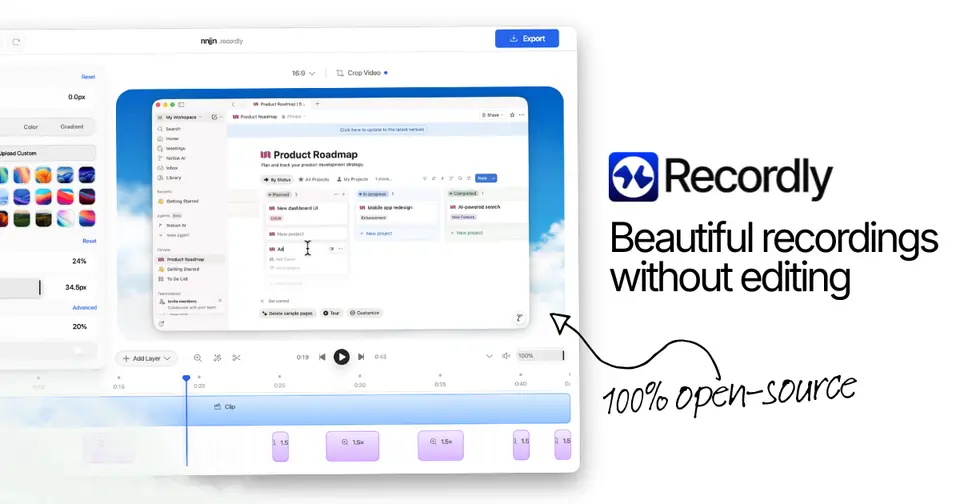
Recordly is a free, open-source desktop app for recording the screen and turning the result into a polished demo or walkthrough. It suggests zooms from cursor activity, smooths the cursor, places the recording in a styled frame and adds a webcam bubble, all on a drag-and-drop timeline. It runs on macOS, Windows and Linux, exports MP4 or GIF, and is licensed under AGPL 3.0.
Recordly is free to use. See every plan
Good for
- Product demos and walkthroughs with automatic zooms
- People who want this style of recorder at no cost on Windows or Linux
- Developers who want to inspect, extend or build the app themselves
Worth knowing
- It needs macOS 14.0 or later, or Windows 10 build 19041 or later for the native capture helper.
- On Linux the real cursor cannot be hidden, so exports may show both it and the styled cursor, and system audio usually needs PipeWire.
- Support is through GitHub issues; there is no paid plan or support contract.
- The source is under AGPL 3.0, which the site says allows commercial use.
Key features
- Auto-zoom and cursor polish
- Suggests zooms from cursor activity and renders a cursor overlay with smoothing, motion blur, click bounce and a loop mode for cleaner looping exports.
- Frame styling and backgrounds
- Places the recording inside a frame with built-in wallpapers, uploaded images, solid colors or gradients, plus padding, rounded corners, blur and drop shadows.
- Webcam bubble overlay
- Adds webcam footage as a bubble with preset or custom positions, mirroring, roundness and shadow controls, and optional scaling that reacts to zooms.
- Timeline editing
- Drag-and-drop regions set trims, zooms, speed changes, text and image annotations and extra audio. Work is saved as a .recordly project file and reopened later.
- MP4 and GIF export
- Exports MP4 or GIF with a choice of quality, aspect ratio and output size, and for GIFs the frame rate, looping and size presets.
- Extensions and marketplace
- A community extension system adds things such as cursor click sounds, device frames, browser mockups and wallpapers, installed from the Recordly Marketplace.
Recordly pricing
- Starts at
- Free
- Free plan
- The whole app is free and open source under AGPL 3.0, which the site describes as having no paywalls or hidden limits. The developer accepts tips through Ko-fi.
- Free trial
- None listed
| Plan | Price | What you get |
|---|---|---|
| Recordly | $0 | The complete desktop app for macOS, Windows and Linux, as a prebuilt release from GitHub or built from source. |
Read from recordly.dev on Oct 9, 2026. Prices change, so confirm with Recordly before you buy.
Recordly alternatives
- Recordly vs Screen Studio
From $9/mo
- Recordly vs Cap
Free plan · from $29/yr
- Recordly vs FocuSee
Free trial · from $49.99/yr
- Recordly vs Cursorful
Free plan · from $79 one-time
- Recordly vs Tella
Free trial · from $13/mo



Common questions
Is Recordly free?
Yes. Recordly is free to use. The whole app is free and open source under AGPL 3.0, which the site describes as having no paywalls or hidden limits. The developer accepts tips through Ko-fi.
How much does Recordly cost?
Recordly lists one plan. Recordly: $0. Prices were read from recordly.dev on Oct 9, 2026.
What platforms does Recordly work on?
Recordly is available on macOS, Windows and Linux.
Does Recordly have an Android app?
No Android app was listed when its pages were read on Oct 9, 2026. Recordly is listed for macOS, Windows and Linux.
Does Recordly have an iPhone app?
No iPhone app was listed when its pages were read on Oct 9, 2026. Recordly is listed for macOS, Windows and Linux.
Is Recordly open source?
Yes. Recordly is open source, according to its own site.
Who makes Recordly?
Recordly is made by webadderall.
What are the alternatives to Recordly?
The closest alternatives to Recordly in our directory are Screen Studio, Cap, FocuSee, Cursorful and Tella. Each one has a side-by-side comparison with Recordly.
Sources for this page
The prices, plans, platforms and features above were read from these pages on Oct 9, 2026.