
Kimai
Open-source time tracking with invoicing, self-hosted or cloud
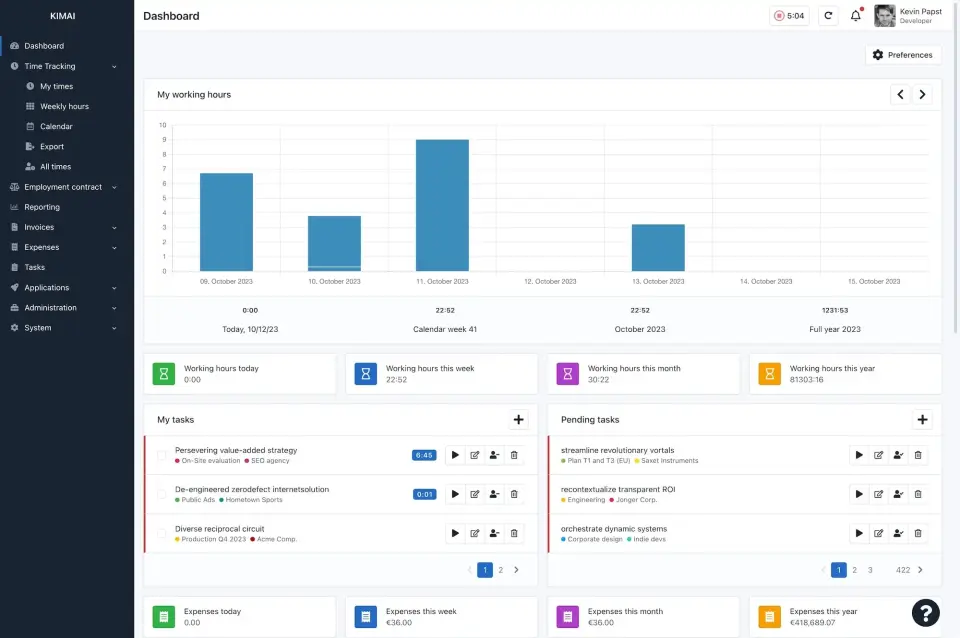
What is Kimai?
Kimai is an open-source, browser-based time tracker for project work. Time is recorded against customers, projects and activities, then analyzed in reports, exported, or turned into invoices from configurable templates. It can be installed on your own server at no cost under the AGPL 3 license, or used as Kimai Cloud, a paid service hosted in Germany and operated by the same developer.
Kimai has a free plan. Paid plans start at €2.99 per user / month, billed annually (€3.99 billed monthly). See every plan
Good for
- Teams that want to host their own time tracking data
- Freelancers and agencies invoicing clients from timesheets
- Organizations that need EU hosting and open-source code
Worth knowing
- Cloud prices are in euros and exclude taxes; the pricing page lists no free cloud plan, only a 30-day trial.
- On Cloud Professional, kiosk mode, SAML single sign-on, a custom domain and IP access restriction are shown only with annual billing.
- Kimai runs in the browser; the mobile and desktop apps on its integrations page are made by third parties, and some are paid.
- Self-hosting needs SSH access to a server, and plugins such as expenses (99 €) are bought separately.
Key features
- Project time tracking
- Time is recorded against customers, projects and activities, with budgets and order numbers on projects. Every installation supports unlimited users with roles.
- Invoicing
- Invoices are created from timesheets with configurable templates and invoice numbers, grouping options for entries, and output formats such as PDF and DOCX.
- Reports and exports
- Recorded time is analyzed by user, customer, project, activity, tag and period. Timesheets export as XLSX, PDF, CSV or HTML, and exported records can be locked.
- Teams and permissions
- Teams group users into units such as departments. Assigning customers and projects to a team limits who can see and record time on them.
- Login and security
- Supports LDAP and SAML login through providers such as Google Workspace, Azure AD or Authentik, plus optional two-factor authentication with TOTP tokens.
- JSON API and plugins
- A JSON API reads and writes data for external apps. Plugins add functions such as expenses, task planning and a kiosk mode with barcode or RFID scanning.
Kimai pricing
- Starts at
- €2.99 per user / month, billed annually (€3.99 billed monthly)
- Free plan
- Self-hosted Kimai is free and open source (AGPL 3) with unlimited users, customers and projects. Extras such as expenses, custom fields and kiosk mode are paid plugins. The Kimai Cloud pricing page lists no free plan.
- Free trial
- 30-day free trial of Kimai Cloud
| Plan | Price | What you get |
|---|---|---|
| Self-hosted | Free | The open-source edition on your own server, installed with Docker or over SSH. Community support; some features are paid plugins. |
| Cloud Standard | €2.99per user / month, billed annually (€3.99 billed monthly) | Hosted time tracking with billable hours, invoicing, data export, audit logs, the JSON API, 5 invoice templates and weekly backups. |
| Cloud Professional | €3.99per user / month, billed annually (€4.99 billed monthly) | Adds working hour accounts, vacation and sick leave, expenses, custom fields, task management, a customer portal and daily backups. |
Read from kimai.org on Oct 6, 2026. Prices change, so confirm with Kimai before you buy.
Ways to pay less
- Annual discount20 to 25% off Kimai Cloud with annual billing
Kimai's discount page says paid cloud plans cost 20 to 25% less when paid annually: Standard is €2.99 against €3.99 a month, and Professional €3.99 against €4.99.
Stated on kimai.org - NonprofitDiscounted annual cloud plan for nonprofits
Nonprofits, schools and clubs that register with an official email address and message support get a reduced annual cloud plan after a manual review.
Stated on kimai.org
Works with
- GrandTotal
- Bexio
- VS Code
- Google Workspace
- Azure AD
Kimai alternatives
- Kimai vs solidtime
Free plan · from €8/mo
- Kimai vs TimeTagger
Free plan · from €3/mo
- Kimai vs Clockify
Free plan · from $3.99/mo
- Kimai vs Toggl
Free plan · from $9/mo
- Kimai vs Harvest
Free plan · from $9/mo





Common questions
Is Kimai free?
Kimai has a free plan. Self-hosted Kimai is free and open source (AGPL 3) with unlimited users, customers and projects. Extras such as expenses, custom fields and kiosk mode are paid plugins. The Kimai Cloud pricing page lists no free plan. Paid plans start at €2.99 per user / month, billed annually (€3.99 billed monthly).
How much does Kimai cost?
Kimai lists 3 plans. Self-hosted: Free. Cloud Standard: €2.99 per user / month, billed annually (€3.99 billed monthly). Cloud Professional: €3.99 per user / month, billed annually (€4.99 billed monthly). Prices were read from kimai.org on Oct 6, 2026.
What platforms does Kimai work on?
Kimai is available on Web.
Does Kimai offer any discounts?
Kimai publicly lists the following: 20 to 25% off Kimai Cloud with annual billing; Discounted annual cloud plan for nonprofits.
Does Kimai have an Android app?
No Android app was listed when its pages were read on Oct 6, 2026. Kimai is listed for Web.
Does Kimai have an iPhone app?
No iPhone app was listed when its pages were read on Oct 6, 2026. Kimai is listed for Web.
Is Kimai open source?
Yes. Kimai is open source, according to its own site. It can also be run on a server of your own.
Does Kimai have an API?
Yes. Kimai offers a public API, according to its own site.
What does Kimai integrate with?
Kimai's listing names GrandTotal, Bexio, VS Code, Google Workspace and Azure AD. A listing names up to eight integrations, so it may connect to more.
Does Kimai have a free trial?
Yes. 30-day free trial of Kimai Cloud.
Who makes Kimai?
Kimai is made by Kevin Papst. It dates from 2006.
What are the alternatives to Kimai?
The closest alternatives to Kimai in our directory are solidtime, TimeTagger, Clockify, Toggl and Harvest. Each one has a side-by-side comparison with Kimai.
Sources for this page
The prices, plans, platforms and features above were read from these pages on Oct 6, 2026.